Safe AI

Engineer safety into AI-enabled systems.

Connect system safety needs to model behavior, data, architecture and verifiable evidence. Our support spans analysis and optimization through runtime safety, verification and preparation for assessment.

Think About Safety Before the Expensive AI Work Starts

Many AI projects begin by proving technical feasibility. But decisions made during data collection, model optimization and system architecture can determine how difficult — and expensive — safety assurance becomes later.

DATA

Are you sure you are collecting the right data?

Common pattern:

Collect as much real-world data as possible — for example millions of kilometres of driving data — and use it to train and improve the model.

Highway traffic with highlighted vehicles and lane detection illustrating driving-data scenarios.

Why safety may require a different approach

Large datasets do not automatically provide sufficient coverage of rare but safety-critical situations. The scenarios that matter most for safety may hardly occur during normal operation.

If they are identified too late, additional data collection, labeling, simulation, retraining and validation may be required.

Solution

Identify safety-relevant scenarios and operating conditions early. Use them to guide targeted real-world data collection, synthetic data and simulation.

MODEL

Are you sure you are optimizing the right model properties?

Common pattern:

Improve the model against one or a few familiar ML metrics — for example accuracy, recall, precision or mAP.

Data feeds into a neural model alongside performance and safety evaluation dashboards.

Why safety may require a different approach

Good average performance can still hide dangerous weaknesses in specific situations.

Safety may depend on critical false negatives, robustness, uncertainty, calibration, temporal consistency or performance under degraded conditions — not only on the headline metric.

Solution

Derive safety-related model properties and KPIs from system hazards and safety goals, then include them directly in model evaluation and optimization.

ARCHITECTURE

Can safety mechanisms simply be added later?

Common pattern:

Develop the AI function first and integrate it into an architecture optimized mainly for functionality and performance.

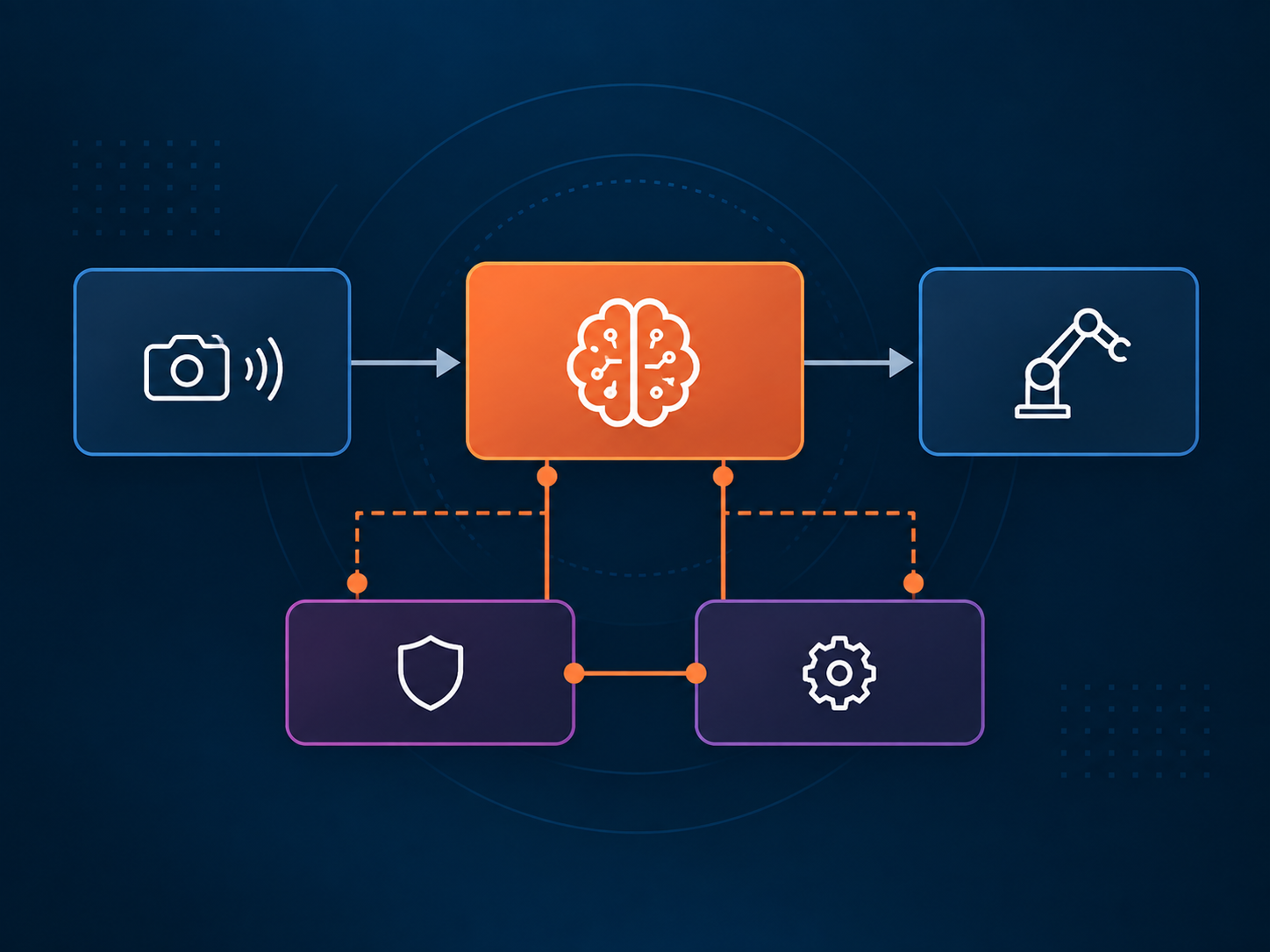
Sensor, AI and robotic actuator connected to independent safety and monitoring mechanisms.

Why safety may require a different approach

The final system may need deterministic guardrails, AI runtime monitors, independent supervision, fallback modes or additional diagnostic channels.

These mechanisms may require access to AI outputs, intervention points, dedicated interfaces, computing resources and defined fallback paths.

If the architecture was never designed to accommodate them, introducing these mechanisms later can require substantial redesign.

Solution

Keep the AI function and system architecture open for safety from the beginning.

Provide observability, intervention points, fallback paths and sufficient resources so monitoring, guardrails and independent safety mechanisms can be integrated when needed.

Early Safe AI engineering is not about completing the safety case during prototype development. It is about making better development decisions before data, models and architecture become expensive to change.

Discuss your AI development approach
The FuSaExperts engineering methodology

From understanding behavior
to building evidence.

Gap analysis is a possible starting point. Safe AI support continues into the engineering work: optimization, architecture, monitors, guardrails, fallback mechanisms, simulation and verification.

  1. 01Analyze

    System, data, model behavior, operational environment, current safety concept and gaps.

  2. 02Optimize

    Safety-relevant properties, KPIs, data quality, robustness, predictability and confidence behavior.

  3. 03Architect

    Independence, deterministic mechanisms, checks, fallback strategies and safety architecture.

  4. 04Monitor

    Runtime monitors, guardrails, confidence checks, OOD handling and temporal consistency.

  5. 05Verify

    Testing, simulation, scenario generation, robustness analysis and fault injection.

  6. 06Prepare for assessment

    Requirements, traceability, evidence and arguments for future assessment activities.

Analyze → Optimize → Architect → Monitor → Verify → Prepare for assessment. Findings feed back into the next engineering iteration.
Engineering depth

Make safety-relevant behavior observable and testable.

Conventional safety methods remain essential. Learned behavior also calls for explicit treatment of data coverage, distribution shift, confidence and model-specific limitations.

Data and model analysis

Data curation, representativeness and coverage; normalization, filtering and logging; gaps, anomalies and weak scenarios; failure-pattern analysis.

  • False positives and false negatives
  • Confidence, calibration and Brier score where useful
  • Robustness and temporal consistency
  • Scenario coverage and out-of-distribution behavior

Optimization and safety properties

Translate reliability, robustness, predictability and explainability into measurable properties. Define relevant KPIs and thresholds, then evaluate improvements in the actual operating context.

Refine data and models alongside the system architecture. A favorable metric alone is not a complete safety argument.

Architecture and runtime safety

Develop safety envelopes, independent checks, deterministic safety mechanisms and separation between AI functions and their safety supervision.

  • Runtime monitors and guardrails
  • Plausibility and confidence checks
  • OOD detection and safe-action selection
  • Degraded modes, fallback and safe-state transitions

Verification and assurance

Combine scenario generation, testing, simulation, fault injection and performance variation with requirements and model reviews.

Organize the resulting evidence in dashboards and structured safety arguments, including GSN where appropriate, and keep its relationship to safety claims traceable.

Safety goalsSafety-relevant propertiesKPIs and thresholdsVerification evidence
Safe AI Lab

Practical work behind
the methodology.

Our Safe AI Lab is the hands-on environment behind our Safe AI offer. We work directly with modern AI technologies, run experiments and simulations, investigate safety-relevant behavior, refine methodologies and validate approaches before applying them in customer projects.

01

AI Model & Runtime Safety

From data weaknesses to observable runtime behavior.

Understand the model

Dataset analysis and gap detection, robustness testing, confidence and calibration analysis.

Observe the system

Temporal consistency, out-of-distribution detection, runtime monitors and guardrails.

Evaluate the response

Fallback and degraded-mode logic, simulation-based verification and reviewable evidence.

02

Robotics & Physical AI Safety

Physical consequence awareness goes beyond collision avoidance.

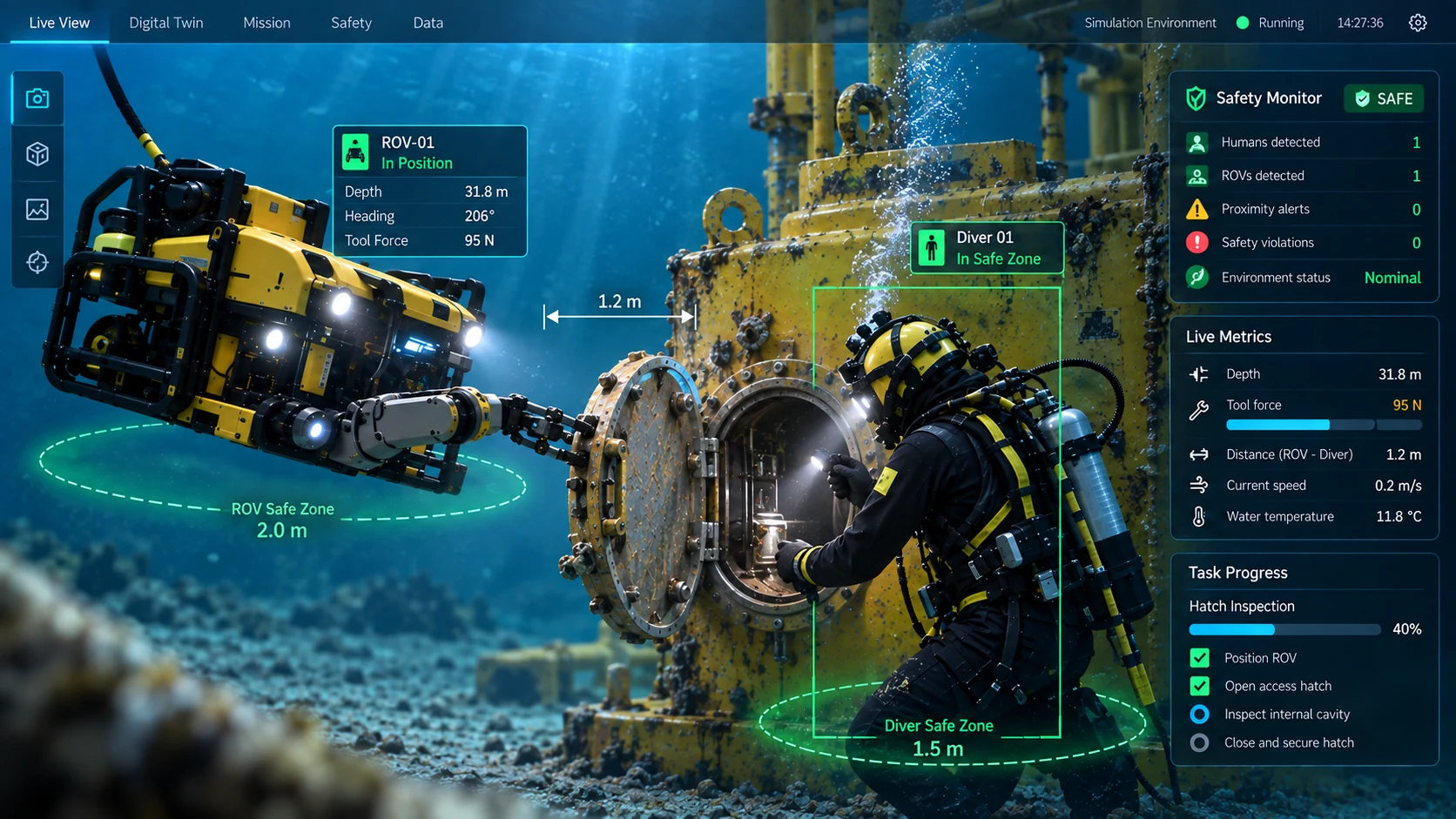
Illustrative underwater simulation: an ROV assists a diver at an inspection hatch, with monitored interaction zones and a dashboard for separation, tool force and environmental conditions.
Underwater inspection illustrates the challenge: controlled human-robot collaboration in a hazardous, partially known physical environment. Dashboard values are illustrative, not validated safety thresholds.View image at full size

Dynamic human-robot interaction

Consider separation, relative motion, reaction time and stopping behavior together to define controlled interaction.

Hazards beyond collision

Account for uncertain conditions, contact forces, stored energy, stability and the consequences of changing the physical environment.

Observable safety performance

Connect runtime monitoring to meaningful safety metrics, intervention criteria and evidence for engineering review.

This visual presents a research and simulation concept, not a finished autonomy capability. Experiments can vary geometry, friction, mass, contact, motion and human proximity to test assumptions and develop safety concepts.

Explore the robotics research in depth ↗
A proportionate start

Move from immediate needs to a sustained safety approach.

Start with one function, one safety concern or one evidence gap. Prioritize quick wins while defining the longer-term methods, responsibilities and work packages.

Support can extend from an initial assessment through implementation, simulation, verification and preparation for future review.

Standards and regulation support the engineering approach.

Relevant frameworks may include ISO 26262, ISO 21448 / SOTIF, ISO 8800 (ISO/PAS 8800), IEC 61508 and the EU AI Act. We identify what applies to the product and distinguish requirements, recommendations and supporting engineering practices.

ISO/IEC 42001 is covered at overview level as an AI management-system standard. It does not replace product-specific safety engineering. AI Act applicability depends on the system, use and organizational role; no automatic compliance outcome is implied.

Discuss your Safe AI system.

Bring the product context, current development stage and the behavior or evidence that needs attention.

Book a discovery call ↗