
Connected safety engineering. Systematic by design.
EcoSafe AI Platform connects safety engineering work products, project knowledge and evidence in one AI-assisted engineering environment. It helps teams work systematically, understand change impact, retain engineering rationale and focus expert effort where engineering judgment matters most.
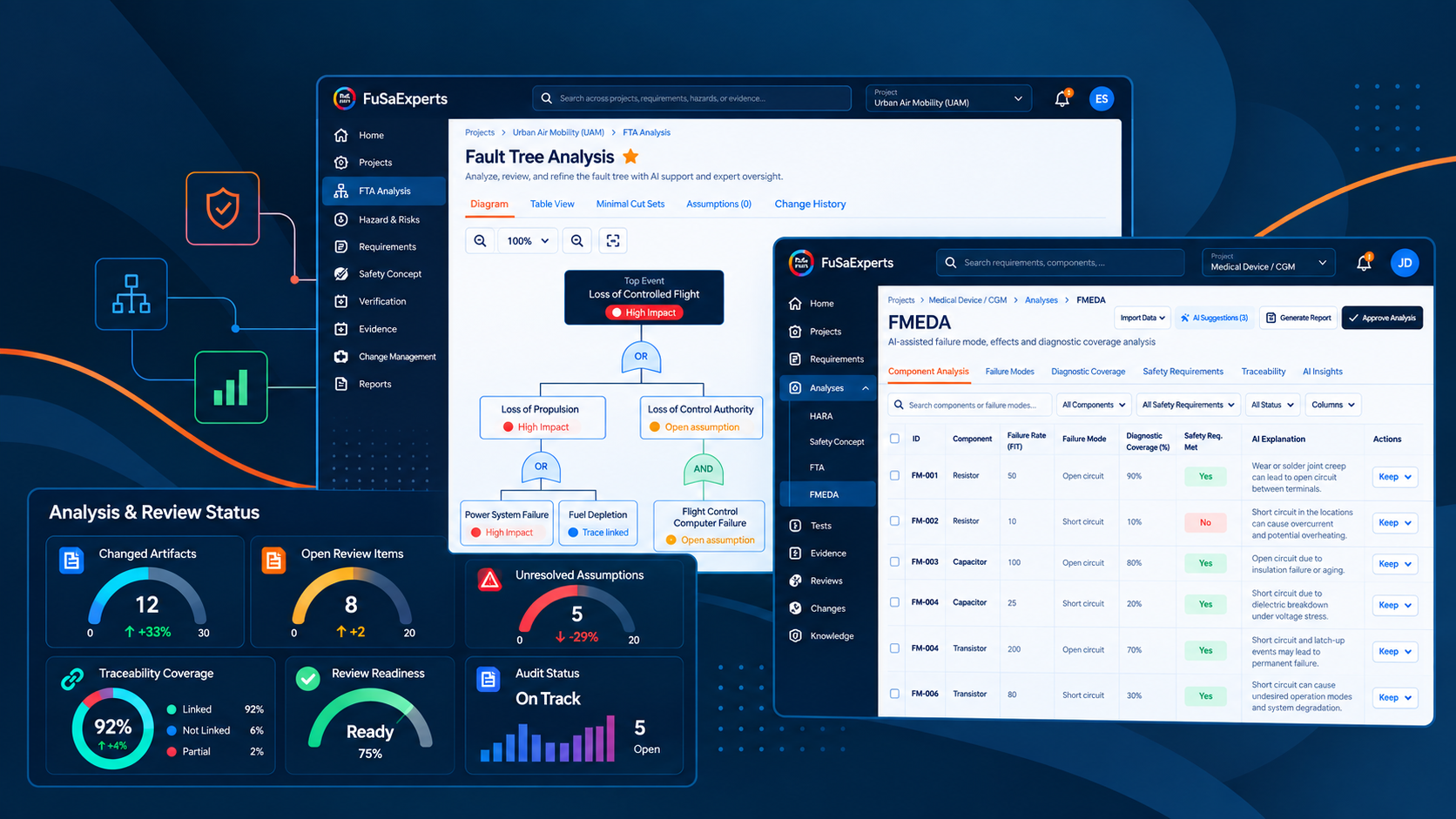
One ecosystem for recurring safety-engineering work
Safety engineering spans many recurring activities such as requirements analysis, impact analysis, hazard analysis, safety concepts, FTA, FMEA/FMEDA, verification and safety-case development.
EcoSafe supports and automates suitable parts of these workflows while keeping them connected through shared project knowledge, traceability, assumptions, rationale and evidence.
Instead of treating each work product as an isolated document or tool output, EcoSafe creates a common engineering context that can be reused as the project evolves.
- Requirements
- Impact Analysis
- HARA
- Safety Concepts
- FTA
- FMEA / FMEDA
- Verification
- Safety Case
One engineering context. Multiple safety workflows.
Built for real safety-engineering challenges
Auditability
Platform-supported decisions remain connected to requirements, analyses, assumptions, evidence and reviews. Their rationale is explained in terms of applicable norms and standards, so that the reasoning is understandable and reviewable, including by an external auditor. The model has been specifically optimized to support this kind of transparent, standards-oriented explanation.
Change management is built in
Because engineering artifacts operate as one connected ecosystem, changes become visible in context. Potentially affected requirements, analyses, tests, assumptions and evidence can be identified earlier and reviewed more systematically.
Traceability through deterministic links and contextual AI
Traceability is supported through deterministic engineering connections combined with context-aware AI analysis. This makes explicit relationships reliable while helping surface less obvious dependencies across work products.
More effective expert reviews
EcoSafe prepares relevant engineering context and highlights gaps, inconsistencies, unresolved assumptions and high-impact changes so experts can focus on engineering judgment instead of searching for information.
Knowledge retention
Rationale, assumptions, decisions, clarification history and engineering relationships remain available to the organization instead of disappearing into documents, meetings or individual experts’ knowledge.
Reduced engineering effort
AI-assisted workflows can reduce repetitive effort across multiple safety-engineering use cases and work products.
Less dependence on fragmented specialist tools
A shared engineering environment reduces manual transfer between isolated tools and can reduce dependence on expensive standalone tooling for suitable work products and workflows.
Continuous improvement through integrated feedback
Review findings, corrections, clarifications and project feedback are retained and can improve subsequent engineering work in a controlled and reviewable way.
Platform architecture
Modern AI, connected engineering knowledge and deterministic safety logic in one platform.
Explore the EcoSafe Architecture
Hover or tap a highlighted component to see what it provides and why it matters.
AIwhere interpretation and synthesis add value.
Deterministic methodswhere reproducibility matters.
Expert approvalwhere engineering responsibility remains.
Robust by design. Improving through controlled feedback.
EcoSafe does not rely on a single unconstrained LLM response. The platform uses multiple layers of protection including project-grounded retrieval, structured engineering context, deterministic checks, traceability to source information and expert review.
Feedback from reviews, corrections, clarifications and accepted engineering decisions can be retained and reused in subsequent workflows. This enables the platform to improve with project experience while keeping changes controlled, transparent and reviewable.
Where AI models are used, their outputs can be checked against engineering rules, project evidence and known constraints. The safety expert remains the final authority.
- Grounded Context
- AI-Assisted Reasoning
- Deterministic Checks
- Expert Review
- Feedback
Start with a pilot on a real workflow.
Select one or two safety work packages, agree a baseline and acceptance criteria, and evaluate EcoSafe against measurable engineering and efficiency goals.