
- 5th September 2026
Robotics Hybrid Safety Concept
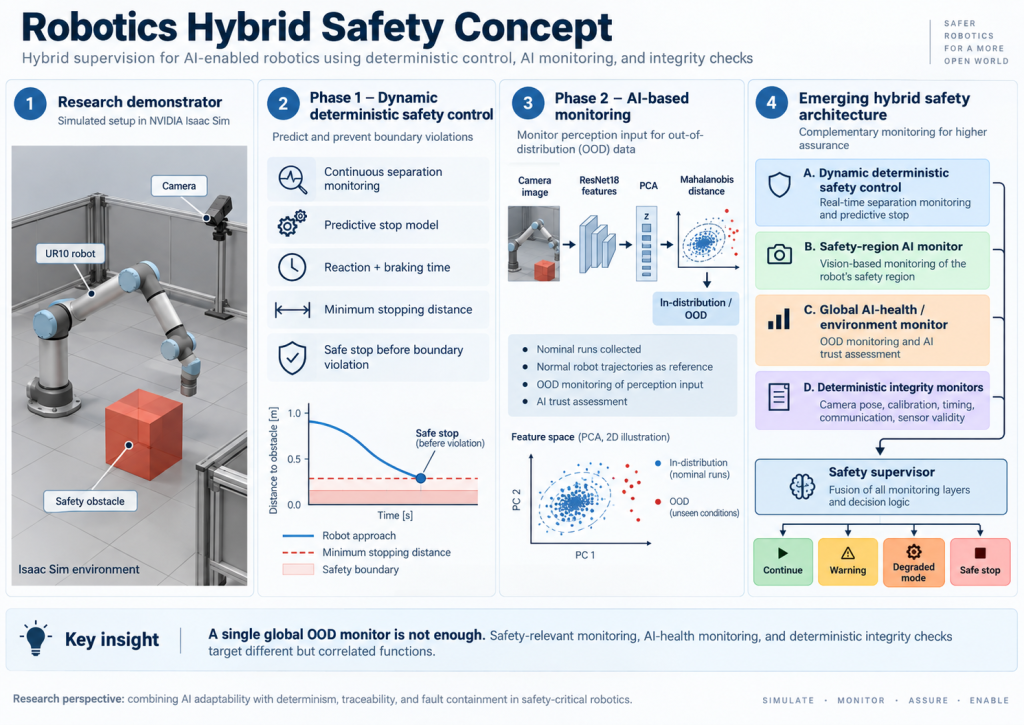
The increasing use of AI-based perception in robotics creates a structural challenge for functional safety: safety decisions can no longer rely only on deterministic state variables, while AI outputs alone are not sufficiently predictable, transparent, or bounded to serve as the sole basis for safety intervention. A promising research direction is therefore a hybrid safety architecture in which deterministic dynamic supervision, AI-based perception monitoring, and independent integrity checks cooperate while retaining distinct responsibilities.
A research demonstrator has been established in NVIDIA Isaac Sim using an industrial UR10 robot, a fixed obstacle, and camera-based perception. In the first phase, a dynamic deterministic safety-control concept was developed, optimized, and introduced. Robot–obstacle separation is evaluated continuously, while a predictive stopping model accounts for reaction time, braking time, robot geometry, and the future trajectory. The resulting supervisor estimates the minimum separation that would occur after an intervention is triggered and initiates a safe stop before the physical safety boundary is violated. The concept was initially evaluated in an open-loop configuration in order to validate the dynamic prediction and stopping behavior independently of AI-based perception.
The second phase introduced AI-based safety monitoring. Camera images are processed using a pretrained ResNet18 feature extractor, producing high-dimensional latent representations. These representations are reduced using PCA and evaluated using a Mahalanobis-distance-based Out-of-Distribution monitor. The nominal distribution was progressively learned from repeated normal robot trajectories and expanded across multiple operating patterns. The experiments demonstrated that OOD behavior depends strongly on how the nominal operating domain is represented: a model trained only on static conditions reacts strongly to normal robot movement, whereas a reference dataset covering repeated trajectories provides a substantially more meaningful characterization of expected operation.
The experiments also revealed that a single global OOD function is insufficient for a safety architecture. A visual anomaly may be statistically unusual without being immediately safety-relevant, while other deviations may indicate latent degradation that could later propagate into a hazardous situation. This motivates a differentiation between a safety-region monitor, focused on the robot interaction area and the immediate trustworthiness of safety-relevant perception, and a broader AI-health and environment monitor, intended to recognize systemic or contextual deviations from the validated operating domain. The two monitoring functions are correlated, but address different aspects of perception integrity and hazard development.
AI-based monitoring is complemented by deterministic integrity monitoring wherever the relevant property can be checked directly. Examples include camera pose and calibration consistency, sensor availability, timing, communication integrity, and other verifiable properties of the perception chain. These deterministic checks provide fault-specific evidence that can complement the more general anomaly indications produced by AI-based monitors.
The emerging Robotics Hybrid Safety Concept therefore combines dynamic deterministic safety control, safety-region AI monitoring, global AI-health and environment monitoring, and deterministic integrity supervision. The central research question is how these channels should be combined, how their diagnostic and safety coverage overlap, and under which conditions they should lead to continued operation, warning, degraded operation, deterministic fallback, or an immediate transition to a safe state.
- 30th August 2026
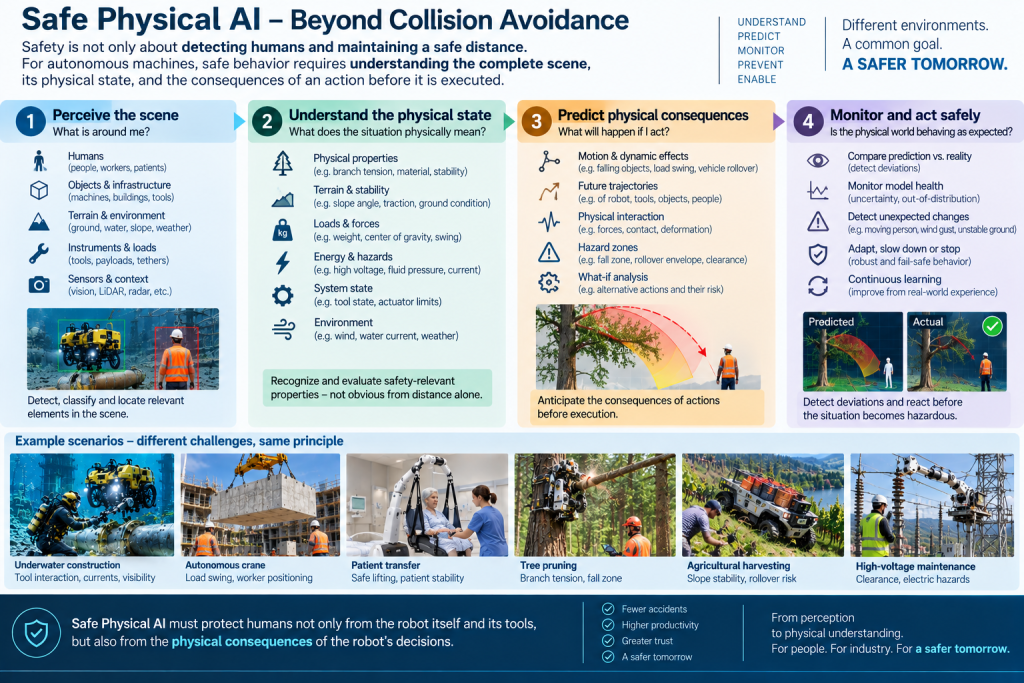
Safe Physical AI goes beyond conventional collision avoidance. Autonomous systems must not only detect people, infrastructure and hazardous tools, but also understand the physical state of the complete scene. Forces, stability, tension, terrain, loads and environmental conditions can determine whether an apparently safe action becomes dangerous. Safety therefore requires the ability to anticipate physical consequences, monitor whether reality develops as expected, and adapt the robot’s behavior when uncertainty or unexpected dynamics
- 27th August 2026
Safety Co-Pilot is moving from individual AI-assisted safety tasks toward a connected safety engineering ecosystem. Our recent development focuses on linking activities such as FMEDA, FTA, DFA, requirements and change impact analysis through common interfaces, traceability and feedback loops. The objective is not only to generate analyses faster, but to continuously check consistency, highlight missing or contradictory information and identify the areas that have the highest impact on safety.
A key step is the integration of clarification, automated review and engineering feedback directly into the workflow. Instead of treating an FMEDA or FTA as a static result, Safety Co-Pilot can identify uncertainties, assess confidence, highlight top contributors and support sensitivity analyses and design improvements. This allows engineers to understand not only what the result is, but also why it matters and where additional engineering work is needed.
The next development stage is focused on deeper integration into existing engineering tool landscapes, stronger deterministic verification and measurable quality KPIs. The target is a system where AI assistance, engineering rules and traceable evidence work together—supporting engineers throughout continuous safety development rather than only automating individual documents.
- 1st January 2026
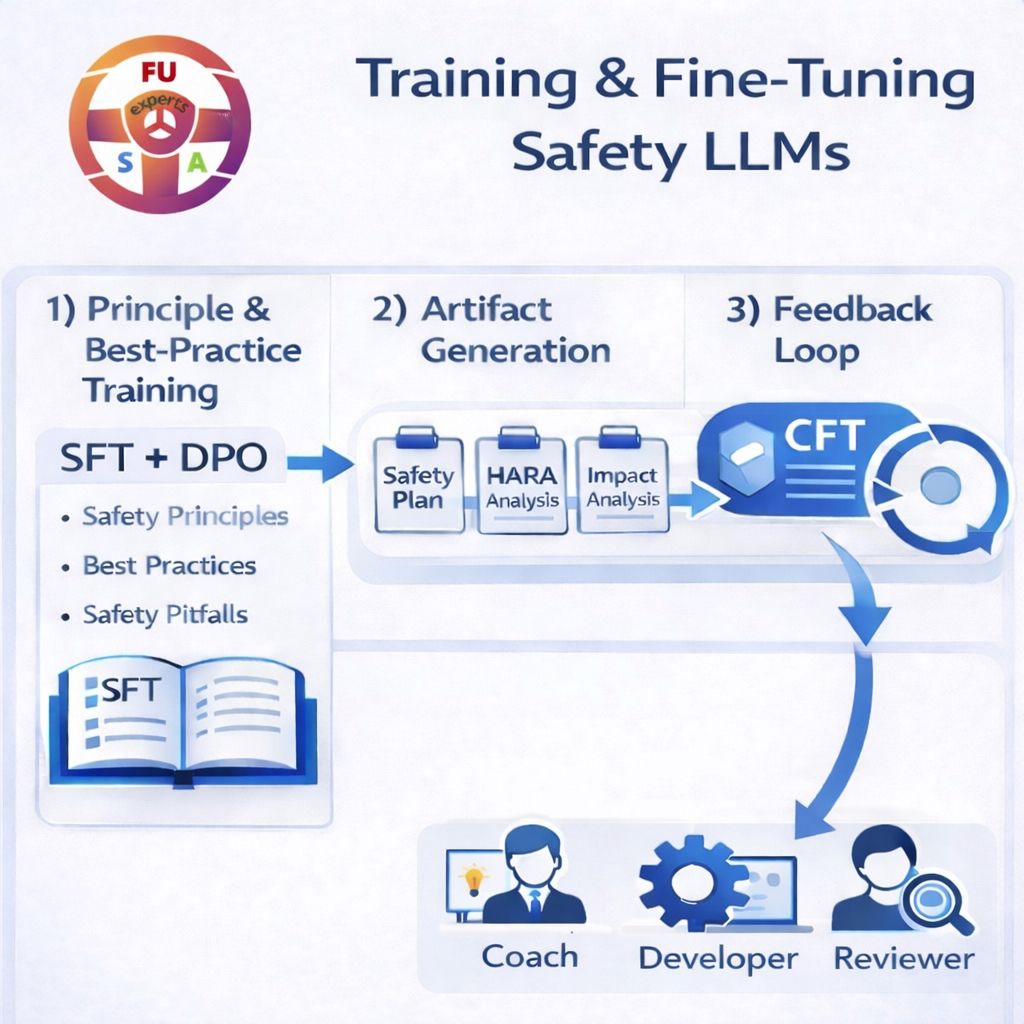
FuSaExperts is training and fine-tuning LLMs specifically for safety engineering—because general-purpose LLMs are not reliable enough for standards-driven work. In functional safety, it’s not about sounding correct; you need consistent application of safety principles, best practices, and repeatable, review-ready outputs across artifacts like Safety Plan, HARA/risk analysis, FSC/TSC, impact analysis, and change management.
Our approach uses fine-tuning methods that match the role and the work package:
SFT (Supervised Fine-Tuning) to teach correct structure, terminology, and expected outputs (templates, content patterns, lifecycle logic).
DPO (Direct Preference Optimization) to align the model with safety-quality preferences (clarity, traceability, conservative assumptions, and fewer hallucinations).
CFT (Critique Fine-Tuning) to harden performance through targeted critiques and revisions—especially important for reviewer behavior and for reducing recurring failure modes.
We apply these methods differently depending on whether the model acts as a Coach, Developer, or Reviewer, and depending on the exact safety task (e.g., safety planning vs. risk analysis vs. impact analysis vs. safety concept).
Our fine-tuning workflow is structured in three phases:
Principles & best-practice training: SFT + DPO to internalize safety engineering principles, accepted best practices, and typical pitfalls seen in audits and assessments.
Artifact production: the model generates real safety work products (structured, traceable, auditable).
Feedback loop: we use CFT on real outputs and review findings to continuously improve quality, consistency, and reviewer readiness.
- 22nd December 2025
We’re introducing a new training: Safe AI — a hands-on program that covers the relevant norms and standards, current and upcoming trends in robust LLMs, the AI safety life-cycle, AI architecture from a safety perspective, safety analysis methods, and safety argumentation; every topic is backed by demonstrations, real-life examples, and concrete case studies so teams can translate the concepts directly into engineering practice.
For more information click here
- 08th November 2025
Call for cooperation / New position open
- 31st July 2025
The development of our AI-based Safety Advisor continues to advance, driven by real-world use-cases across the safety lifecycle — including safety management, impact analysis, and safety analysis. We implemented a Retrieval-Augmented Generation (RAG) framework based on existing safety artifacts, combined with task-specific LLM selection to maximize reasoning accuracy and consistency. To handle structural dependencies across work packages, we introduced LongGraph as a backbone for safety logic flow, supported by a vector database enabling semantic retrieval within context. This setup has already led to measurable improvements, such as the identification of critical change impacts and increased consistency in artifact alignment. In parallel, we are actively strengthening the platform’s robustness through architectural and validation measures to ensure traceable and audit-ready results in compliance-critical environments.
- 24th April 2025
FuSaExperts invites partners to collaborate on advancing AI in safety-critical systems, focusing on two distinct directions:
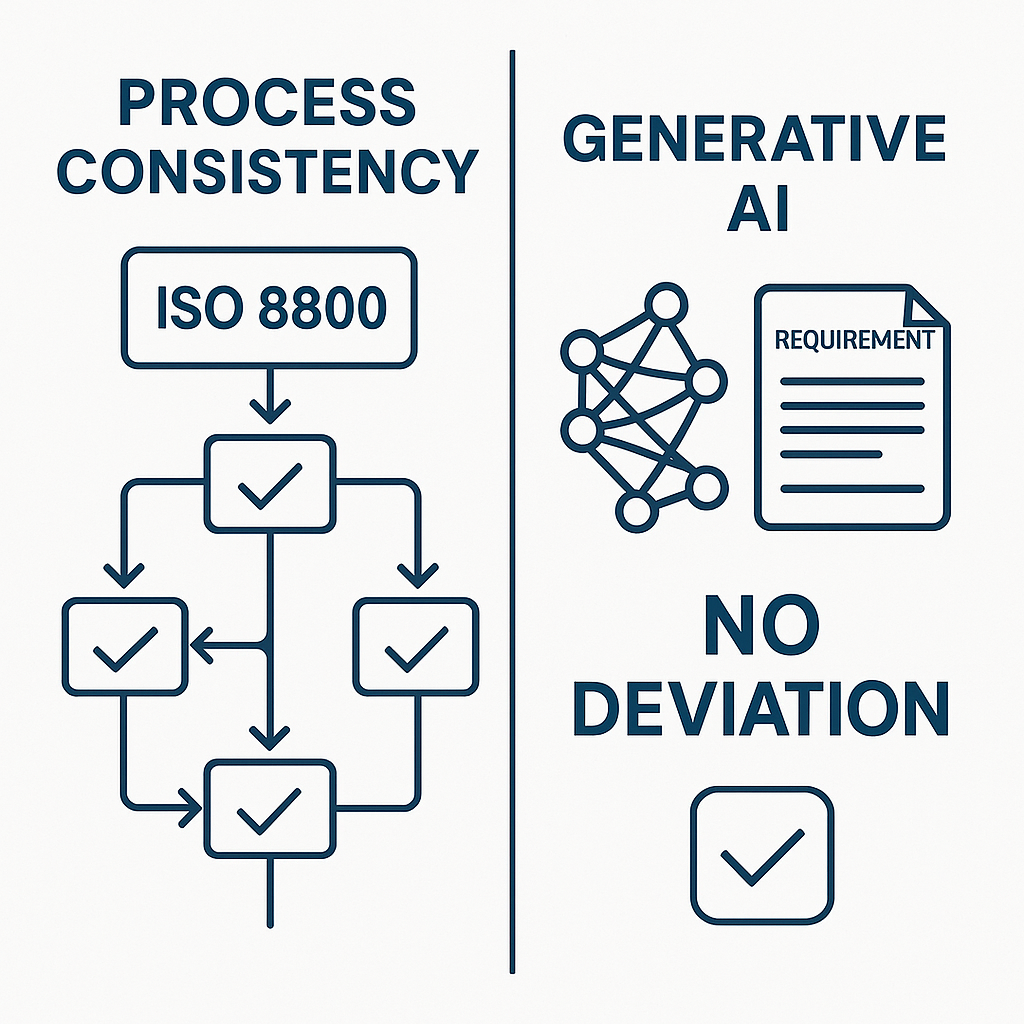
- Process-Driven AI Integration
Aligned with standards such as ISO 8800, the company ensures AI integration through strict process consistency, prioritizing safety and reliability in compliance with recognized norms. - Generative AI for Development and Safety Justification
Leveraging customized LLMs, FuSaExperts supports the development and safety justification of critical systems, ensuring zero deviation from specified requirements for full compliance.
- 27th January 2025
We are excited to announce the launch of our new training program, “Functional Safety for Managers”, designed to empower leaders with the knowledge and skills to effectively integrate functional safety into their management practices. This comprehensive training is tailored to meet the unique challenges managers face in safety-critical industries.
Training Highlights:
- Understanding Safety Culture:
- Importance of fostering a safety-first mindset across the organization.
- Strategies to embed safety culture into daily operations.
- Integrating Safety and Quality:
- The synergy between safety and quality for achieving operational excellence.
- How to balance compliance with efficiency.
- Workflow Design and Effort Estimation:
- Building workflows that align with functional safety requirements.
- Techniques for accurate effort estimation in safety-related tasks.
- Defining Roles and Responsibilities:
- Clear delegation of safety-related roles within teams.
- Ensuring accountability and collaboration for effective implementation.
- Safety Assessment:
- Principles of functional safety assessment and key deliverables.
- Preparation for audits and continuous improvement cycles.
Interactive Case Study:
- Safety Planning in Action:
- Hands-on exploration of a real-world scenario.
- Developing and executing a functional safety plan from initial concept to review stages.
- Identifying common pitfalls and implementing solutions.
This training is ideal for managers who oversee safety-critical projects or are involved in decision-making processes related to safety and quality. With this course, participants will gain actionable insights and practical tools to elevate their leadership in functional safety.
For more information or to register, contact us today!
12 December 2025
Safety Tool Chains. This event will bring together industry leaders, experts, and innovators to explore strategies for optimizing workflows, enhancing safety protocols, and integrating advanced tools to drive progress across the field.
Event Details:
- Topic: Engineering and Safety Tool Chains: Challenges, Innovations, and Future Directions
- Date: 20th December 2024
- Time: 09:00 a.m. PST
- Location: on-line
Agenda:
- Current Landscape: An overview of engineering tool chains and safety standards.
- Challenges & Opportunities: Identifying gaps and potential improvements in current practices.
- Innovation Showcase: Presentations on emerging technologies and solutions.
- Collaborative Exchange: Open forum for discussions, ideas, and networking.
- Strategic Outcomes: Actionable steps for future advancements.
Who Should Attend?
This event is designed for professionals, decision-makers, and stakeholders in engineering, safety, and related industries. Whether you’re looking to share your expertise, gain insights, or collaborate on pioneering solutions, this discussion offers a unique opportunity to connect with like-minded individuals.
Please register by 12th of November 2024 by e-mail to secure your place
We look forward to welcoming you to this collaborative event and working together to shape the future of engineering and safety tool chains.