
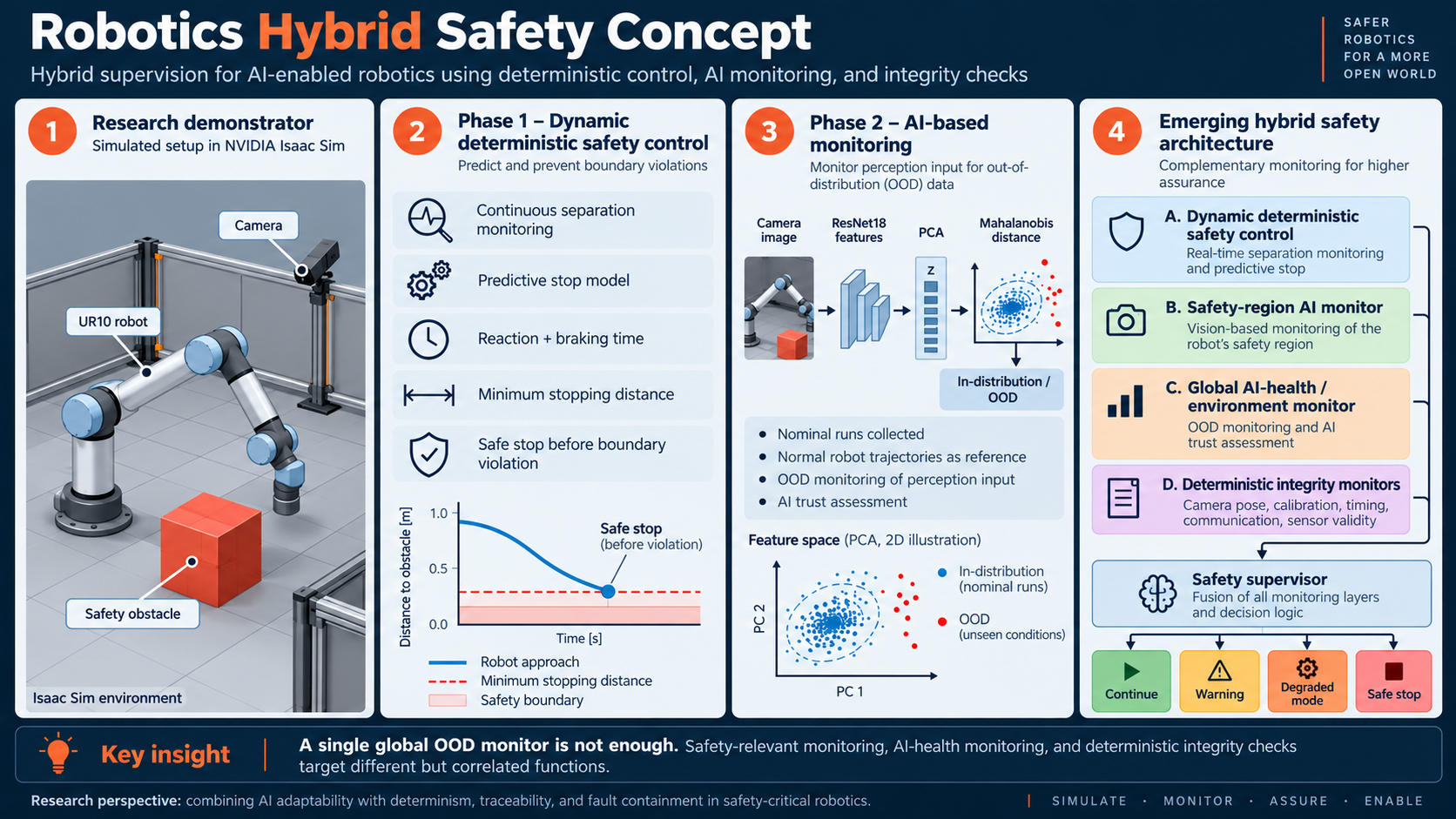
The increasing use of AI-based perception in robotics creates a structural challenge for functional safety: safety decisions can no longer rely only on deterministic state variables, while AI outputs alone are not sufficiently predictable, transparent, or bounded to serve as the sole basis for safety intervention. A promising research direction is therefore a hybrid safety architecture in which deterministic dynamic supervision, AI-based perception monitoring, and independent integrity checks cooperate while retaining distinct responsibilities.
A research demonstrator has been established in NVIDIA Isaac Sim using an industrial UR10 robot, a fixed obstacle, and camera-based perception. In the first phase, a dynamic deterministic safety-control concept was developed, optimized, and introduced. Robot - obstacle separation is evaluated continuously, while a predictive stopping model accounts for reaction time, braking time, robot geometry, and the future trajectory. The resulting supervisor estimates the minimum separation that would occur after an intervention is triggered and initiates a safe stop before the physical safety boundary is violated. The concept was initially evaluated in an open-loop configuration in order to validate the dynamic prediction and stopping behavior independently of AI-based perception.
The second phase introduced AI-based safety monitoring. Camera images are processed using a pretrained ResNet18 feature extractor, producing high-dimensional latent representations. These representations are reduced using PCA and evaluated using a Mahalanobis-distance-based Out-of-Distribution monitor. The nominal distribution was progressively learned from repeated normal robot trajectories and expanded across multiple operating patterns. The experiments demonstrated that OOD behavior depends strongly on how the nominal operating domain is represented: a model trained only on static conditions reacts strongly to normal robot movement, whereas a reference dataset covering repeated trajectories provides a substantially more meaningful characterization of expected operation.
The experiments also revealed that a single global OOD function is insufficient for a safety architecture. A visual anomaly may be statistically unusual without being immediately safety-relevant, while other deviations may indicate latent degradation that could later propagate into a hazardous situation. This motivates a differentiation between a safety-region monitor, focused on the robot interaction area and the immediate trustworthiness of safety-relevant perception, and a broader AI-health and environment monitor, intended to recognize systemic or contextual deviations from the validated operating domain. The two monitoring functions are correlated, but address different aspects of perception integrity and hazard development.
AI-based monitoring is complemented by deterministic integrity monitoring wherever the relevant property can be checked directly. Examples include camera pose and calibration consistency, sensor availability, timing, communication integrity, and other verifiable properties of the perception chain. These deterministic checks provide fault-specific evidence that can complement the more general anomaly indications produced by AI-based monitors.
The emerging Robotics Hybrid Safety Concept therefore combines dynamic deterministic safety control, safety-region AI monitoring, global AI-health and environment monitoring, and deterministic integrity supervision. The central research question is how these channels should be combined, how their diagnostic and safety coverage overlap, and under which conditions they should lead to continued operation, warning, degraded operation, deterministic fallback, or an immediate transition to a safe state.
← More insights