
01 / Interaction
Separation is dynamic.
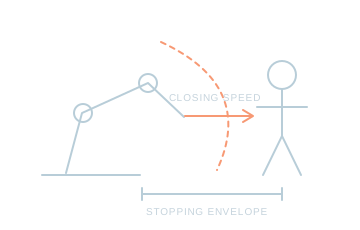
Assess human/robot distance together with closing speed, reaction time, braking behavior and the stopping envelope.
Collision avoidance is essential, but physical safety also depends on support, load, stability, connectivity and stored energy across the wider scene.
Customers benefit from: simulation of hazardous physical interactions, development of safety envelopes and runtime monitors, analysis of indirect and cascading consequences, and structured evidence for requirements and safety cases.
Assess human/robot distance together with closing speed, reaction time, braking behavior and the stopping envelope.
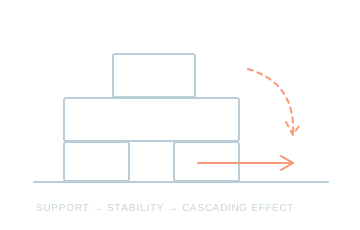
Investigate support relationships, load paths, stability and cascading effects when objects are moved or removed.
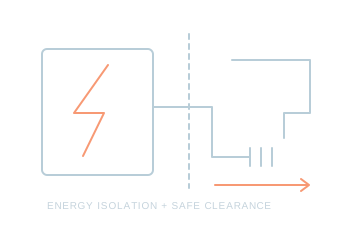
Examine stored energy, high-voltage clearances, cable loading and isolation during collaborative maintenance.
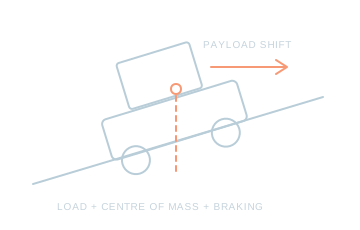
Vary payload, centre of mass, friction and braking demand to investigate stability and motion on slopes.
A robot may avoid direct contact with a person and still create danger by removing structural support, shifting a load, releasing tension, destabilizing stacked objects or triggering a cascading event.
Customers can commission focused simulation and safety-concept activities. The wider capability for physical consequence awareness remains active research and is not presented as a finished autonomy product.
Scene understanding, support and contact relationships, stability, load paths, connectivity and cascading physical effects.
Runtime monitors, safety envelopes, guardrails, safe-action selection and fallback strategies.
Hazardous scenarios, fault injection and evidence for verification, safety requirements and safety cases.
The sequence makes the required reasoning explicit and therefore easier to test.
Each case can vary geometry, friction, mass, contact, motion and human proximity to build structured evidence.
An object appears free to grasp but supports an unstable load above it.
A payload shift changes the centre of mass, braking demand or rollover margin.
Manipulating a connected part releases tension, pressure or elastic energy outside the immediate workspace.
Motion changes clearances, cable loading or access to energized equipment.
Support, posture, contact force and fallback behaviour interact throughout the action.
Moving one object changes the stability of connected or resting objects elsewhere.
We welcome focused research, simulation and safety concept activities with robotics developers and technology partners.